Collaboration breaks down without visibility
Sales collaboration rarely fails because teams don’t want to work together. More often, it fails because people don’t share the same view of reality. When deal status, ownership, or recent activity isn’t clearly visible, teams start working from assumptions instead of facts. Updates get lost in messages, meetings become status checks, and decisions slow down.
In growing sales teams, this problem compounds quickly. More people touch the same deals, more handoffs happen, and more context is required to move forward smoothly. Without visibility, collaboration becomes reactive—teams spend time clarifying what already happened instead of focusing on what should happen next.
Visibility creates a shared source of truth
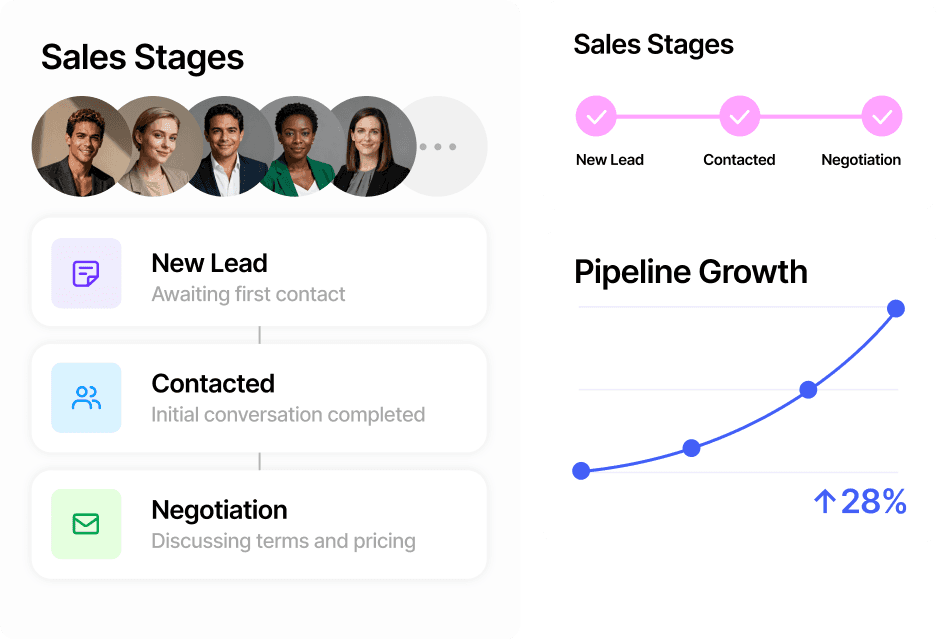
Effective collaboration starts with a shared source of truth. When everyone can see the same pipeline, stages, and activity history, alignment becomes natural. Team members don’t need to ask for updates or dig through tools to understand progress—they can see it instantly.
This shared visibility reduces friction across roles. Sales reps know what’s expected of them, managers understand where attention is needed, and leadership gains confidence in the accuracy of the pipeline. Instead of relying on individual reporting, teams align around a single, transparent system that reflects the current state of the business.
Clear ownership enables better teamwork
Visibility isn’t only about seeing deals—it’s about understanding responsibility. When ownership is unclear, follow-ups get missed, decisions stall, and accountability weakens. Clear visibility into who owns each deal, task, or stage removes ambiguity and supports better teamwork.
With ownership clearly displayed, collaboration improves across boundaries. Team members know when to step in, when to wait, and when to support. This clarity is especially important in remote or distributed teams, where casual alignment through conversation is less frequent. Visibility replaces guesswork with confidence.
Activity timelines turn collaboration into context
One of the most powerful forms of visibility is context over time. Activity timelines—showing emails sent, meetings held, notes added, and tasks completed—give teams a full picture of how a deal is evolving. This context prevents duplicated outreach, awkward follow-ups, and misaligned conversations.
When collaboration is grounded in shared context, teams move faster and communicate better. New team members can step into deals without lengthy handovers, and managers can coach based on real activity rather than summaries. Visibility turns collaboration from coordination into execution.
Activity timelines turn collaboration into context
Visibility as a foundation for scale
As sales teams grow, visibility becomes less of a convenience and more of a requirement. Scaling without visibility leads to chaos: inconsistent processes, unreliable forecasts, and teams pulling in different directions. With it, teams can grow while maintaining clarity and control.
Visibility doesn’t mean surveillance—it means alignment. When teams trust the system and the information it provides, collaboration becomes easier, decisions become faster, and growth becomes more sustainable. In modern sales organizations, visibility isn’t just a feature—it’s the foundation of effective collaboration.